


The Spark
In this growth mindset brain science article, discover
- Why do some people learn from mistakes while others shut down after failure?
- The three brain systems that shape motivation, persistence, and learning
- How your beliefs about ability influence the way your brain responds to challenges
- Why a fixed mindset can interrupt learning at the neurological level
- How neuroplasticity allows the brain to change and adapt over time
- The Brain Science Behind Growth Mindset
- 3. Your Brain’s Motivation System
- How These Systems Work Together
- How Your Beliefs Become Your Reality
- Growth Mindset Brain Science and Neuroplasticity
- Reflection: Notice Your Own Response to Difficulty
- What Growth Mindset Brain Science Really Shows
- Questions That Often Arise
Most people think of mindset as a motivational idea or personality trait. But growth mindset brain science tells a much deeper story. Neuroscience research shows that the way you think about your abilities can directly influence how your brain responds to mistakes, effort, and learning.
But neuroscience tells a much more interesting story.
Your mindset is not just a belief floating around in your thoughts. It is connected to real activity inside your brain. Researchers studying growth mindset brain science have found that different neural networks activate depending on how people interpret challenge and failure.
In other words, the way you think about your abilities changes the way your brain behaves during learning.
That matters more than most people realize.
Because when your brain interprets mistakes as useful information, learning stays active. But when mistakes feel threatening, the brain can begin shifting into protection mode instead.
“A growth mindset keeps the brain in learning mode. A fixed mindset pushes it toward self-protection.”
This helps explain something we have all seen before:
Why do some people recover quickly, while others immediately shut down? Why one person sees a challenge as exciting while another experiences it as proof they “are not good enough.”
Why do two people with similar ability levels end with completely different outcomes over time?
The surprising part is this:
These patterns are not permanent.
The brain can change how it responds to difficulty. And understanding the science behind that process gives us a clearer picture of what a growth mindset really is.
So let us explore what is happening inside the brain when people learn, struggle, adapt, and improve.
The Brain Science Behind Growth Mindset
For a long time, mindset sounded abstract to me. Helpful, yes, but vague. Then I started reading neuroscience research, something fascinating:
Mindset has a physical footprint in the brain.
Different brain systems become more or less active depending on how someone interprets mistakes and challenges. Scientists can measure these responses in real time.

And once you understand how these systems work together, a lot of human behavior suddenly makes sense.
1. Your Brain’s Error Detector
Deep inside the brain sits a small region called the anterior cingulate cortex, or ACC.
You don’t need to remember the name. What matters is its job.
Think of the ACC as the brain’s internal alarm system for mistakes. It constantly compares what you expected to happen with what actually happened. When something goes wrong, it sends a signal that says:
“Wait. Something didn’t go as planned. Pay attention.”
That signal is incredibly important for learning.
Because before the brain can improve, it first has to notice that improvement is needed.
Here is where mindset changes the picture.
Studies show that people with a growth mindset tend to have stronger brain responses after making mistakes. Their brains stay engaged. Errors become information.

Instead of unconsciously reacting with:
“I failed.”
The brain shifts toward:
“Something here can be adjusted.”
But in people with a fixed mindset, the response often looks different. When mistakes feel tied to identity or self-worth, the brain may treat them more like threats than learning opportunities. As a result, the error-detection system becomes less engaged.
It is almost as if the brain starts looking away from the very information that could help it improve.
Not because the person is lazy or incapable. Because the brain is trying to protect them from discomfort.
And that protective response can quietly interfere with learning over time.
“The brain often learns the most when it has to correct itself.”
Related Resources:
2. Your Brain’s Strategy Center
Now, let us move to another important region near the front of the brain: the dorsolateral prefrontal cortex.
Again, the scientific name matters less than the function.
This area helps you think strategically. It is involved when you:
- Break a hard problem into steps,
- Try a different approach,
- Stay focused under pressure,
- Resist the urge to quit,
- Or deliberately work through confusion.
In simple terms, this is the part of the brain that helps you adapt instead of react.
Research shows that people with a growth mindset tend to activate this region more strongly during challenges. Their brains stay involved in problem-solving.
Instead of asking: “Am I smart enough for this?”
The brain shifts toward: “What can I try next?”
That is a completely different mental experience.
With a fixed mindset, however, difficult situations often trigger disengagement earlier. Strategic thinking decreases because the brain is busy managing threat and self-protection.
The challenge feels personal rather than solvable.
Same obstacle. Different brain response.
And over time, those repeated responses shape habits, confidence, and skill development.
3. Your Brain’s Motivation System
There is another set of brain regions that plays a major role in mindset.
These areas help answer a question your brain asks constantly:
“Is this worth the effort?”
Your brain is always calculating whether something feels rewarding enough to continue. That calculation influences whether you persist after failure, avoid difficulty, or keep practicing long enough to improve.

This is where mindset becomes especially powerful.
In people with a growth mindset, the brain tends to assign value to learning itself. Progress feels meaningful. Effort feels useful. Challenges can even become motivating.
The brain begins associating struggle with growth instead of inadequacy.
But with a fixed mindset, effort can start to feel pointless. If the brain believes ability is mostly fixed, then hard work may seem like evidence that you lack talent rather than evidence that you are learning.
And when effort feels meaningless, motivation naturally drops. From the brain’s perspective, disengaging can actually feel logical.
This is one of the central discoveries in growth mindset brain science: learning is shaped not just by ability, but by how the brain responds to difficulty.
How These Systems Work Together
These brain systems don’t operate separately. They function like a team.
Imagine someone trying to learn a difficult skill.
First, the brain notices a mistake. The error detector says: “Something went wrong.”
Then the strategy system responds: “Let us figure out another approach.”
Finally, the motivation system evaluates: “This is still worth the effort. Keep going.”
That cycle supports learning.

Mistakes lead to reflection. Reflection leads to adaptation. Adaptation leads to improvement.
But in a fixed mindset pattern, the cycle can break down much earlier.
Mistakes trigger threat. Threat reduces engagement. Disengagement interrupts learning.
Many of the limits people experience are not simply about talent. They are about whether the brain stays engaged long enough to learn.”
Over time, those repeated patterns shape real-world ability. And this leads to one of the most important insights in neuroscience:
Many of the limits people experience are not simply about talent. They are about whether the brain stays engaged long enough to learn.
How Your Beliefs Become Your Reality
This is where mindset becomes deeply personal. Imagine a student who believes:
“I am just not a math person.”
Every difficult problem now carries emotional weight.
Mistakes feel discouraging instead of informative. Effort feels exhausting instead of productive. Avoidance becomes more likely.
Over the years, that student practices less, engages less deeply, and develops less confidence. Eventually, the belief appears true.
But the original belief may have shaped the outcome.
Now imagine another student who believes:
“I can improve with practice.”
That doesn’t mean learning suddenly becomes easy. They still struggle. They still fail sometimes. They still get frustrated.
But their brains remain more engaged during difficulty. Mistakes become part of the process instead of incapability. And because they stay engaged longer, learning compounds over time.
That is the hidden power of mindset. It doesn’t magically create talent overnight.
“Mindset doesn’t magically create talent. It changes whether the brain continues participating in learning.”
It changes whether the brain continues participating in learning.

Growth Mindset Brain Science and Neuroplasticity
One of the most hopeful findings in growth mindset brain science is that these neural patterns are not fixed.
The brain is adaptable. Neuroscientists call this neuroplasticity, which simply means the brain can reorganize itself through experience and repetition.
Neuroplasticity: Brain networks strengthen through repeated use
The more often certain thought patterns and behavior are repeated, the stronger those neural connections become.
That means the brain can gradually learn new responses to challenges.
A person who once shut down after mistakes can learn to stay curious. Someone who avoids difficulty can build tolerance for struggle. Patterns of avoidance can slowly become patterns of persistence.
“Your brain can learn new responses to challenge, failure, and difficulty.”
Not instantly. Not perfectly. But genuinely.
And that changes how people learn, work, and grow across their lives.
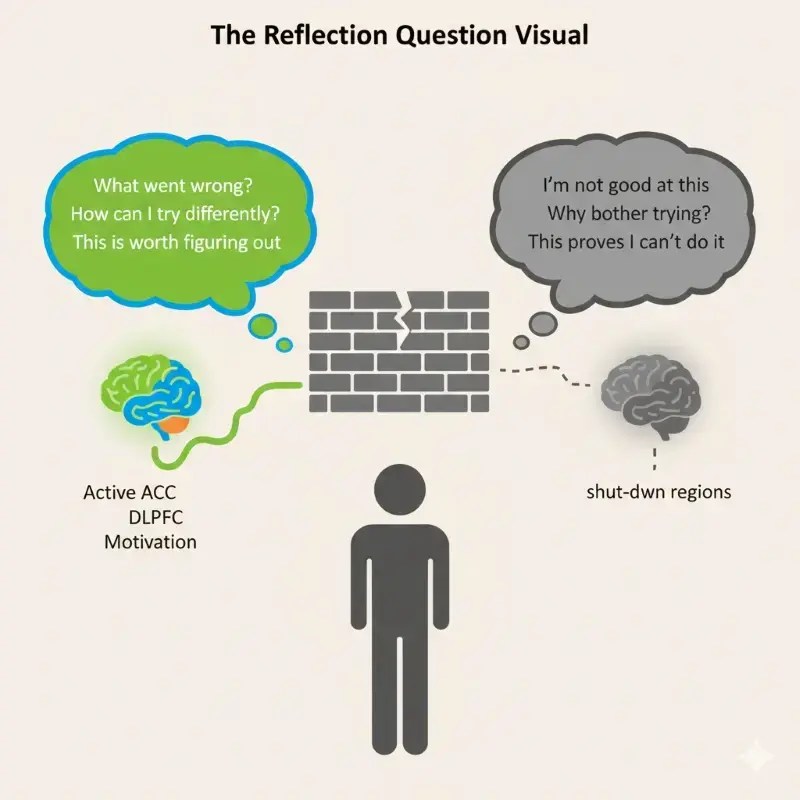
Reflection: Notice Your Own Response to Difficulty
Think about the last time you struggled with something important.
Maybe you made a mistake at work. Failed a new skill. Felt overwhelmed trying to learn something unfamiliar.
What happened inside your mind afterward?
- Did you become curious? (“What can I learn from this?)
- Did you start problem-solving? (“Maybe I should try another approach.”)
- Or did the experience trigger self-doubt? (“Maybe I am just not good at this.”)
That reaction matters. Because it offers a glimpse into the patterns your brain has practiced over time. And once you become aware of those patterns, you can begin changing them.
What Growth Mindset Brain Science Really Shows
A growth mindset is not just positive thinking. It is not pretending failure feels good. It is not blind optimism. And it is not motivation fluff.
It is a measurable pattern of brain activity tied to earning, effort, adaptation, and persistence.
Your brain constantly decides:
- Whether mistakes are threats or information,
- Whether effort is worthwhile,
- And whether challenges deserve continued engagement.
A growth mindset keeps those learning systems active. A fixed mindset tends to push the brain toward protection and withdrawal.
But neither pattern is permanent. The brain changes through repetition, experience, and awareness. Which means the way you respond to challenge today does not have to define the way you respond forever. Every day, learn to reset your mind for positive growth.
At its core, growth mindset brain science shows that the brain remains adaptable throughout life.
Questions That Often Arise
Your mindset shapes how your brain responds to mistakes and challenges. A growth mindset activates brain regions involved in error detection, strategic problem-solving, and motivation, keeping your learning systems engaged rather than shutting them down after setbacks.
Three key regions work together: the anterior cingulate cortex (detects and processes errors), the dorsolateral prefrontal cortex (develops strategies and solutions), and the ventromedial prefrontal cortex (assigns value to learning efforts). Together, they form a network that supports learning from challenges.
Mistakes create what scientists call a “prediction error,” a signal that something unexpected happened. When the brain treats this signal as valuable information rather than a threat, it triggers neural adjustments that strengthen learning and improve future performance.
Absolutely. Mindset reflects learned patterns of brain activity and connectivity. With consistent experiences and intentional practice, these neural patterns can reorganize, allowing your brain to respond to challenges in healthier, more adaptive ways. This is neuroplasticity in action.
In a fixed mindset brain, errors trigger threat responses that shut down learning systems. In a growth mindset brain, errors activate regions involved in deeper processing, strategic thinking, and sustained motivation, keeping you engaged with challenges rather than withdrawing from them.
No. Growth mindset isn’t about optimism or self-talk. It is about how your brain interprets effort and errors, whether it processes them as signs of personal failure or as information for learning and improvement. It is a neurological pattern, not a mood.