


The Spark
Wake up anxious? You are not alone. Over 40 million Americans experience morning anxiety, but here is the good news: your brain’s default “operating system” can be reset in just 2 minutes.
What you will learn in this guide:
- Why your brain floods you with anxious thoughts the moment you wake up (and how to interrupt this pattern)
- A 5-step morning routine backed by neuroscience that reduces stress before your day even starts.
- The “mistake contract” technique stops errors from derailing your entire day.
- How to rewrite your brain’s predictions in under 5 minutes
- Why avoiding your phone for 2 minutes changes everything.
Time to read: 9 minutes. Time to implement: 20 minutes daily
Mornings used to be my favorite part of the day.
That quiet stillness.
That smell of coffee.
That calm moment before life got loud.
Waking up early once felt grounding. It gave me space to think, breathe, and ease into the day instead of being thrown into it.
Then something changed.
I still woke up early, but the peace was gone. The moment I opened my eyes, my mind flooded with anxious thoughts and heavy predictions. It felt like my brain had been waiting for me to wake up just so it could unload everything at once.
My heart rate jumped. And before my feet even touched the floor, the familiar thoughts were already there:
- “Today is going to be insane.”
- “I am already behind.”
- “I don’t have the energy for this.”
I had not done anything yet, and my brain was already running in survival mode.
“If you wake up anxious, stressed, or mentally exhausted before the day even starts, this is for you.”
Once I started thinking about mindset as the brain’s operating system, everything shifted. I stopped trying to “fix myself” and instead built a simple 20-minute morning mindset routine to reset the system.
It is not about perfection. It is not about discipline hacks.
And it is definitely not about becoming a new person overnight.
It is about starting the day from a calmer, more supportive mental baseline.
Let us walk through it together.
Whether you are heading to work, school, or managing life at home, this routine fits into real mornings
Why a Morning Mindset Routine Matters
Think of your brain like a smartphone.

When you wake up, your mental operating system automatically boots with default settings:
- default predictions (“Today will be stressful”)
- default reactions (scrolling, worrying, rushing)
- default identity stories (“I’m always behind” or “I can’t keep up”)
Want to go deeper? Neuroscientist Dr. Lisa Feldman Barrett explains how your brain is predictive, not reactive, and why this changes everything about how we understand anxiety and emotions.
If you don’t interrupt those defaults, they quietly shape your entire day.
“This morning mindset reset is not about forcing positivity. It is about making small adjustments so your brain starts the day with more flexibility and less fear.”
Over time, those tiny changes shift your defaults:
- from “I am already behind” to “I know how to start.”
- from “Everything is too much” to “I can handle one step at a time.”
- from “Mistakes will ruin everything” to “Mistakes are part of learning.”
The 20-Minute Morning Mindset Reset Routine
This routine works even if you are tired, busy, or not a morning person. Coffee, messy hair, and yesterday’s T-shirt are all welcome.
Minute 0–2: Don’t Touch Your Phone (Reduce Morning Anxiety)
When your alarm goes off, your habit might say: grab the phone, check the world.
Instead, wait two minutes.
No meditation. No pressure to feel calm. Just don’t reach for your phone.
This small pause tells your brain: “I decide how my day starts, not my notifications.”
You can stare at the ceiling, take a few slow breaths, or simply notice your body waking up.
Quick Tip: Put your phone across the room before bed so you have to physically get up to reach it. Those extra steps break the automatic grab-and-scroll habit.
That is it. This is your first quiet win of the day.

Minute 2–7: Reset Your Daily Predictions
Now grab a notebook or your notes app. This is the only time the phone is allowed.
Ask yourself: “What is my brain predicting about today?”
Write down three honest predictions. like:
- “That meeting will go badly.”
- “I won’t finish my tasks.”
- “I will mess something up.”
Now, under each one, write a more useful alternative prediction. Not toxic positivity. Just something more flexible and realistic.
Example:
- Old: “The meeting will go badly.”
New: “It might feel awkward, but I can ask one clear question and leave with one next step.” - Old: “I won’t finish my tasks.”
New: “I will focus on the two tasks that matter most.”
You are not trying to convince yourself. You are giving your brain another script to run.
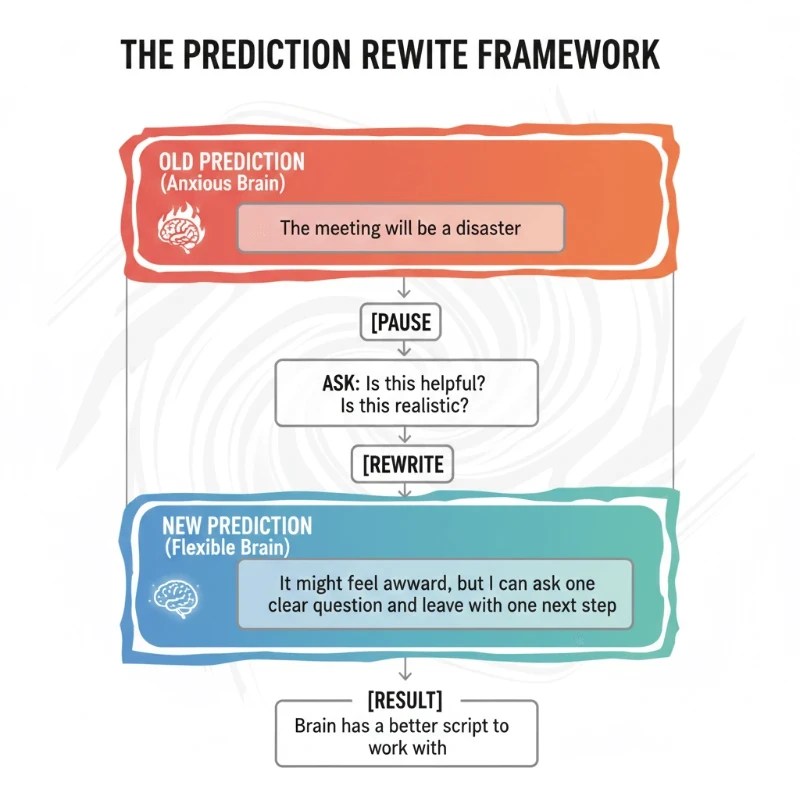
“When you rewrite your predictions, you are not lying to yourself. You are giving your brain better options to work with.”
The science behind this: Research shows that anxiety is actually a prediction error in the brain, which means we can update those predictions with practice.
Quick Tip: Keep this prediction journal by your bedside. The act of physically writing (not just thinking) creates a stronger mental shift.
Minute 7–12: Decide How You Will Handle Mistakes
Most stressful days are not ruined by events. They are ruined by how we interpret mistakes.
So now you make a small “mistake contract” with yourself.
Write this sentence and complete it:
“Today, when I mess up or feel awkward, I will…”
Choose one response to practice all day:
- “…pause, take one slow breath, and ask: ‘What is this trying to teach me?’”
- “…write one line about what I would do differently next time.”
- “…remind myself: ‘This is learning, not failure.’”
Pick one and stick with it.
You can even make it more real by writing:
“Mistakes I expect today:” and list one or two (e.g., “I might stumble in that call,” “I might forget something.”)
This trains your brain to expect mistakes without panicking.
“Errors become part of the day’s design, not proof that you are broken.”
Dive deeper: Stanford researcher Carol Dweck’s decades of research on growth vs. fixed mindsets shows exactly why this shift in thinking about mistakes changes everything.

Quick Tip: Expecting mistakes is not pessimistic. It is realistic. When you plan for imperfection, you spend less energy being shocked when it happens.
Minute 12–17: A Small Effort Ritual
Now give your brain a physical reminder that effort is not dangerous.
Harvard research reveals how exercise triggers neuroplasticity and literally helps your brain grow new connections.
Choose one:
- A 2-minute wall sit
- 20 slow squats or push-ups
- 3 minutes of brisk walking
- 30 seconds of cold water on your face
While you do it, say something simple:
- “This discomfort means growth.”
- “I don’t need to like this. I just need to finish it.”
Some days you will feel motivated. Other days you will hate it. Both are fine.
The win is doing something on purpose that your brain tried to avoid.
Quick Tip: Start with the easiest option. If 20 push-ups sound impossible, do 5. If cold water sounds terrible, try cool water. Progress beats perfection every single time.
Minutes 17–20: Visualize Your Future Self
Close your eyes and imagine yourself 90 days from now, still doing this routine.
Notice the differences:
- You don’t reach for your phone right away.
- Your predictions are calmer and more flexible.
- When something goes wrong, you adjust instead of collapsing.
- You move through the morning with a little more steadiness.
Feel what that version of you is like.
Then ask: “What is one small thing that version of me does today that I can do now?”
Write it down.
That is your bridge from this routine into real life.
“You are not trying to control the day. You are training the system that meets the day”

What This Morning Routine Looks Like in Practice
Put together, your 20 minutes might look like this:
- 0–2 min: Breathe. No phone.
- 2–7 min: Write and rewrite three predictions.
- 7–12 min: Decide how you will handle mistakes.
- 12–17 min: Do one small effort ritual.
- 17–20 min: Visualize your future self and choose one action.

Nothing here is fancy. But done consistently, this routine changes how your brain:
- Starts the day
- Handles stress
- Responds to mistakes
- Relates to effort and discomfort.
A Gentle Reminder as You Begin
This routine is not a test.
Some mornings you will skip parts.
Some days you will rush.
Some days you will still feel off.
That doesn’t mean it is not working.
Mindset change happens quietly. One morning at a time.
And tomorrow, when your alarm goes off, and your old habit whispers, “Just scroll, nothing will change,” you will know better.
Change doesn’t start with a big, dramatic decision.
It starts with 20 quiet minutes where you choose to boot your brain differently.

Start Tomorrow Morning
You don’t need to be perfect. You don’t need special equipment. You don’t even need to feel motivated.
You just need 20 minutes and a willingness to try something different.
Your brain is already wired to protect you. This routine simply teaches that calm mornings, flexible thinking, and self-compassion are part of that protection.
So set your alarm. Put your phone across the room. And give yourself permission to start small.
Your future self, the one who wakes up a little calmer, a little steadier, is waiting for you to begin.